Know where your crisis organisation stands.
Show that it learns.
One environment for the quality management of your crisis organisation: evaluating against a fixed yardstick, recurring threads that get followed through, and readiness from exercise and response data alike. Set up in your own language and structure — and yours to manage after the start.
What it delivers
Standardised question sets, tied to assessment frameworks. The team starts the AAR; the log and self-reflection surveys attach to it easily. The report generates itself, in your own branding.
Created automatically, with evaluations, surveys, attendance, action items, files and timeline in one place. If a question about this response comes up a year later, it is all in one dossier — not in five folders.
Dashboards show the picture without separate administration: attendance and readiness per team, role and person — and which themes keep returning, and how their follow-up stands.
The improvement matrix tracks per theme what is open, closed or returning; every action item has an owner and a deadline — traceable back to the source evaluation.
Per team, role group and person it is visible what has been exercised and responded to, set against the objectives in your training programme. The planner takes the legwork away.
Not only teams, roles and terminology: recurring training, locations, email templates and the labels of the improvement matrix follow your set-up as well — and are yours to manage.
One yardstick for exercise and real response
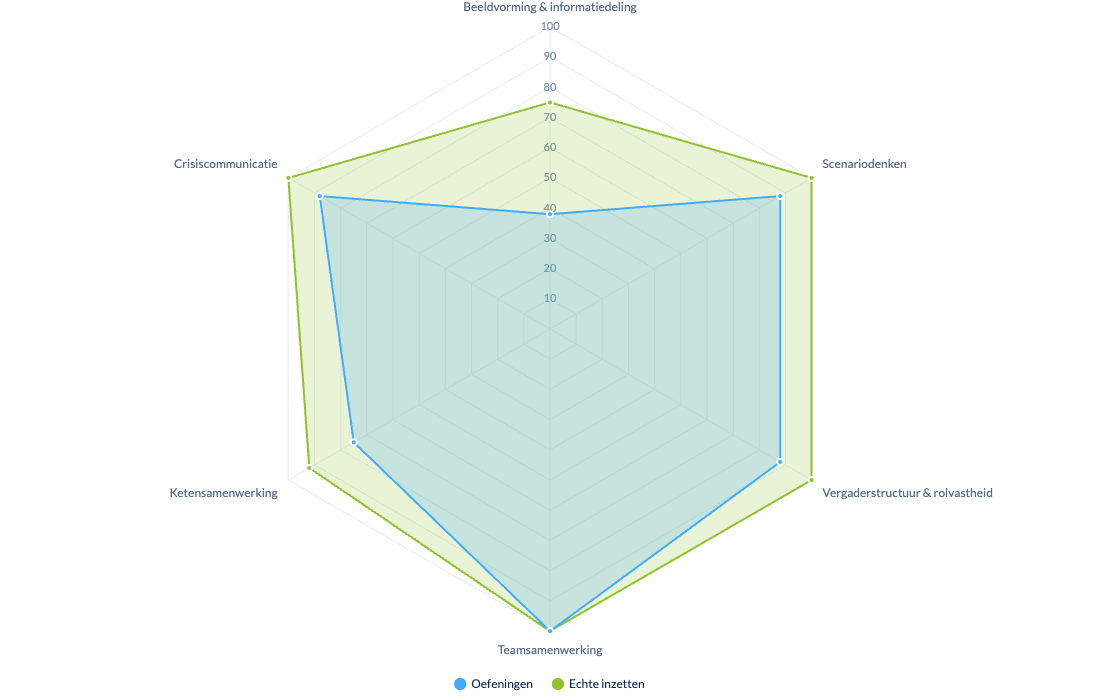
The pain: every exercise gets its own questionnaire and its own report. What went differently under real pressure than in the exercise is therefore invisible — and whether the team’s self-image holds up, no one knows.
The value: one fixed yardstick. Standardised question sets, tied to assessment frameworks, against which exercise and real response are judged on the same criteria. Afterwards a self-reflection survey brings in the wider picture — each role sees its own topics, anonymously if preferred, so every voice counts and not only that of the team at the table. The report writes itself: answers, log entries and feedback come together in your own branding, downloadable as Word or PDF.
The proof: the same criteria, filled in by the team and by an independent observer — the gap between self-image and observation comes out of the system, not out of the advisor. Feedback is placed alongside an answer, the answer itself stays unchanged; once archived, the evaluation is locked.
Recurring threads: see what returns, follow through on what stays
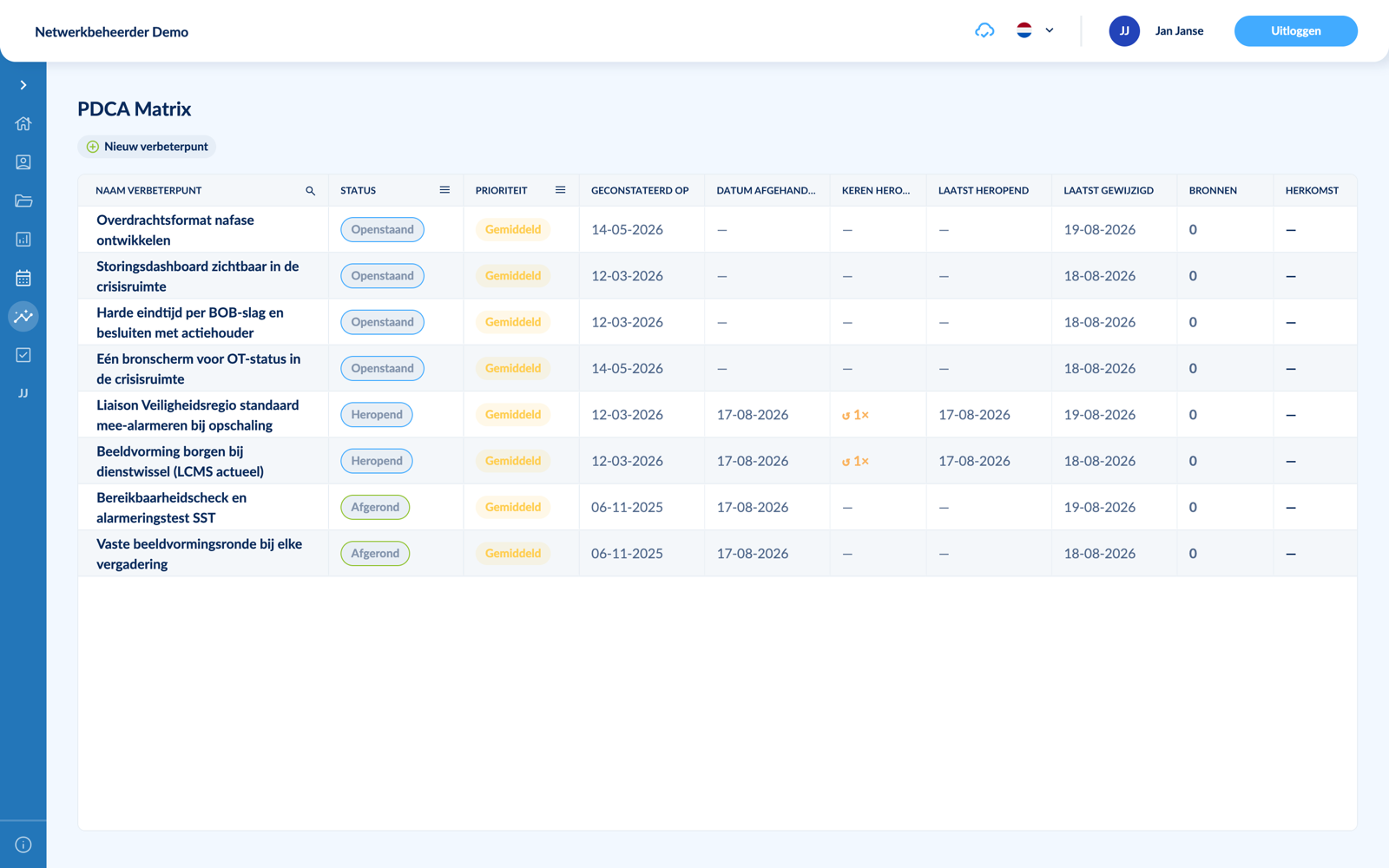
The pain: the big recurring thread gets fished out of old reports by hand, and no one checks whether “closed” was really the end. Whatever stands out between two evaluations drops away entirely.
The value: activities, evaluations and surveys feed the same matrix — across exercises and real responses alike. Per theme and per year it shows what is open, what is closed, and what returned after having been closed once already. Every item gets an owner and a deadline; the owner accepts or rejects it with reasons, including from outside your organisation through an email link without an account. The optional reporting point catches the signals between two evaluations.
The proof: the improvement matrix and the action item register, every item traceable back to the source evaluation and reviewable years later. If a thread keeps returning, a study links response and competence data, with a freezable snapshot as its foundation.
Readiness: from exercise and response data alike
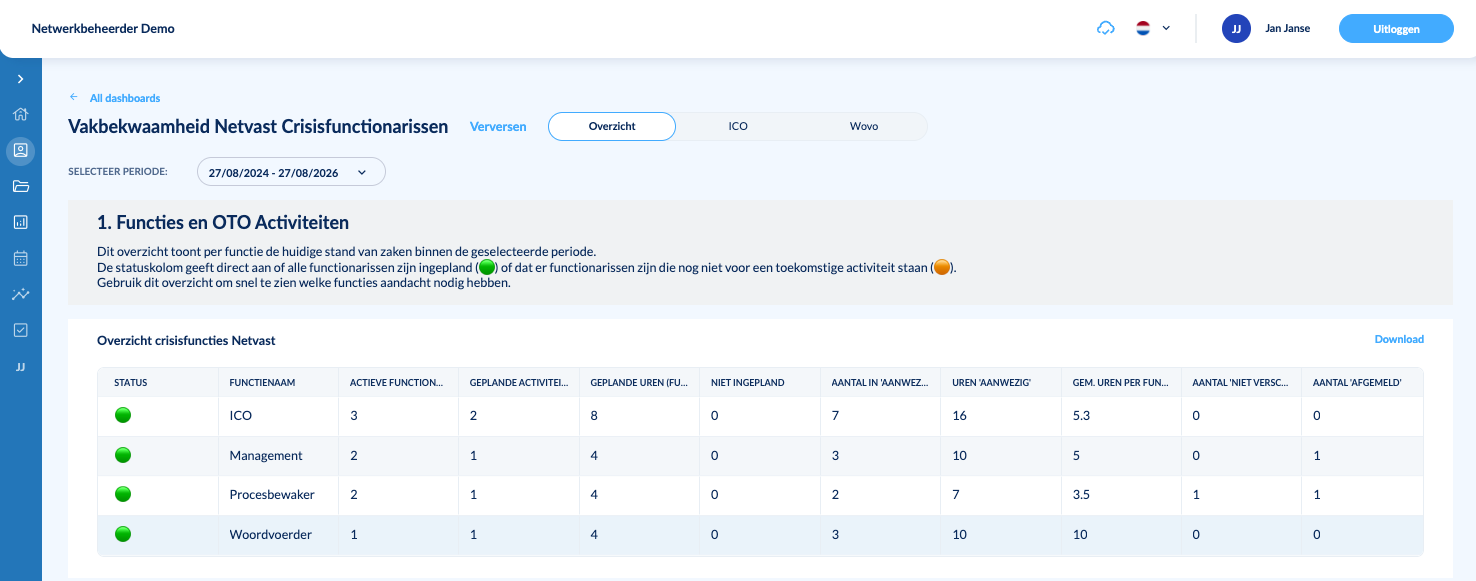
The pain: the state of the organisation is now gut feeling, a spreadsheet and a round of phone calls — exposed for you personally and toward the board. And scheduling an exercise now costs more time than the exercise itself.
The value: training data tells you what has been exercised, response data shows how it works when it counts; here they come together. Invitations go out from the planner, with the calendar entry attached automatically — if the time or location changes, everyone’s calendar updates by itself. Cancelling is only possible with a reason, anyone absent without notice is registered separately, and the trainer fills in attendance on the day through a link, without an account.
The proof: the state of training per team, role and person; the coverage of the annual objectives, down to the objective that still has no activity; the staffing level per unit, including vacancies. And each responder’s personal dashboard — their own mirror, and the factual basis for the development conversation.
Set up around your organisation, then yours to manage
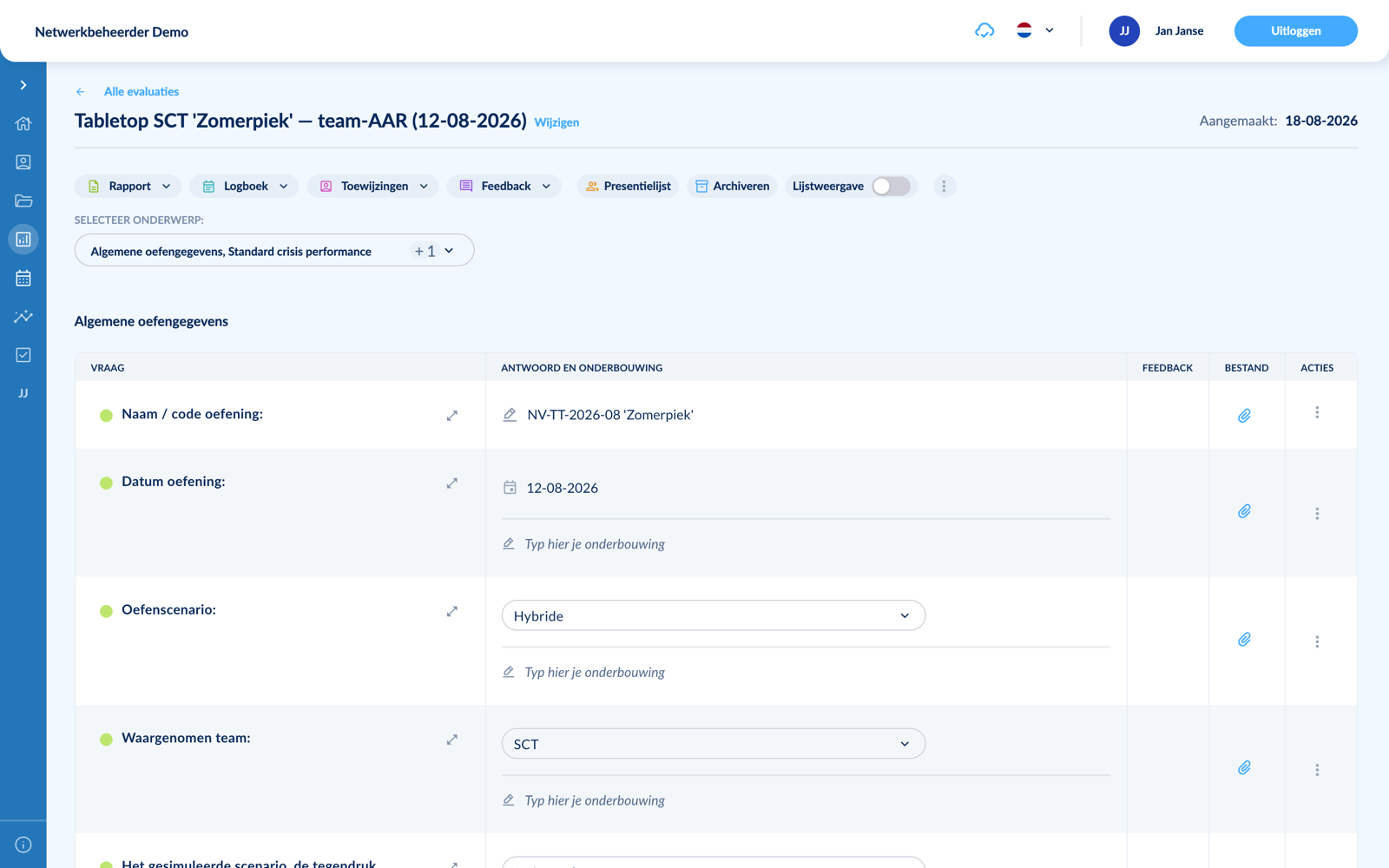
The pain: generic tools force a crisis organisation into someone else’s structure — everything is called by another name, and nothing fits. And anyone wanting to adjust the system later has to go back to the supplier.
The value: your teams, roles and terminology appear in the header of every evaluation, and each role is only shown its own topics. Whatever changes after that — a new role, a different template, different labels in the improvement matrix — you enter yourself in the administration module. Anyone without an account, from trainer to chain partner to board member, takes part through a secure link.
The proof: the crisis organisation as it is named at your place, in the screen the responder fills in.
Demonstrable to the board and the regulator
The board sees readiness per team and role, how the annual exercise plan is being carried out, and the recurring threads with their follow-up — current, through a secure link without an account.
Archived evaluations and reports are locked: the foundation toward the regulator and the auditor, reviewable years later.
Development points for the annual plan and the next meeting come straight out of the dashboards — no round of asking about.
The cycle the directives ask for emerges as a by-product of doing the work — no separate reporting project needed. What the directives actually ask →
A working method, not a software purchase
Buying an app does not help a crisis organisation; the working method needs to be embedded — in its own roles and language, carried by its own people. That happens guided, at the moments that matter: at set-up, at the first exercises, and in the follow-through on what they surface. Until the learning cycle runs on its own — and no longer. Why this comes with people →